


Candela: The Number on the Box That Actually Matters
Walk into any gun shop or scroll through any weapon light listing and you’ll see one number plastered everywhere: lumens. “800 Lumens.” “1,000 Lumens.” “SUPER ULTRA MEGA 1,200 LUMENS.” It’s the spec that marketing departments love and the one most buyers anchor to, because higher is obviously better, right?
Except lumens doesn’t tell you what you actually need to know. And in a tactical context, whether that’s a dark parking garage, a hallway at 2 a.m., or a vehicle stop on an unlit road, the wrong number can put you at a real disadvantage.
The number that matters is candela. And we’re going to explain exactly why, without the physics lecture.
At a glance
- Lumens vs. Candela: The Fire Hose Analogy
- The Concept Nobody Explains: Retinal Authority
- The Inverse Square Law: Your Secret Weapon
- The Candela Spectrum: What You Actually Need
- The Spill Trap
Lumens vs. Candela: The Fire Hose Analogy
Here’s the clearest way to think about it. Imagine two options for watering a field:Option A: A fire hose blasting water in every direction. Total water output? Enormous. Effectiveness at soaking one specific plant 40 yards away? Minimal.Option B: A pressure washer with a narrow nozzle. Same water volume. But all of it focused into a tight, fast stream that reaches exactly where you point it.Lumens is total light output. It measures every photon leaving that LED in every direction, including the ones bouncing off the inside of the housing and going nowhere useful. It’s the fire hose number.Candela is beam intensity: how many of those photons you’ve successfully concentrated into the direction you’re actually pointing the light. It’s the pressure washer number.A light can have massive lumens and mediocre candela, and in a real tactical scenario, that light will underperform a dimmer one with superior beam focus. Every time.
This is why your buddy’s camping lantern is “brighter” in his garage but your weapon light reaches further down the driveway. The lantern floods. Your light throws. The difference is candela.
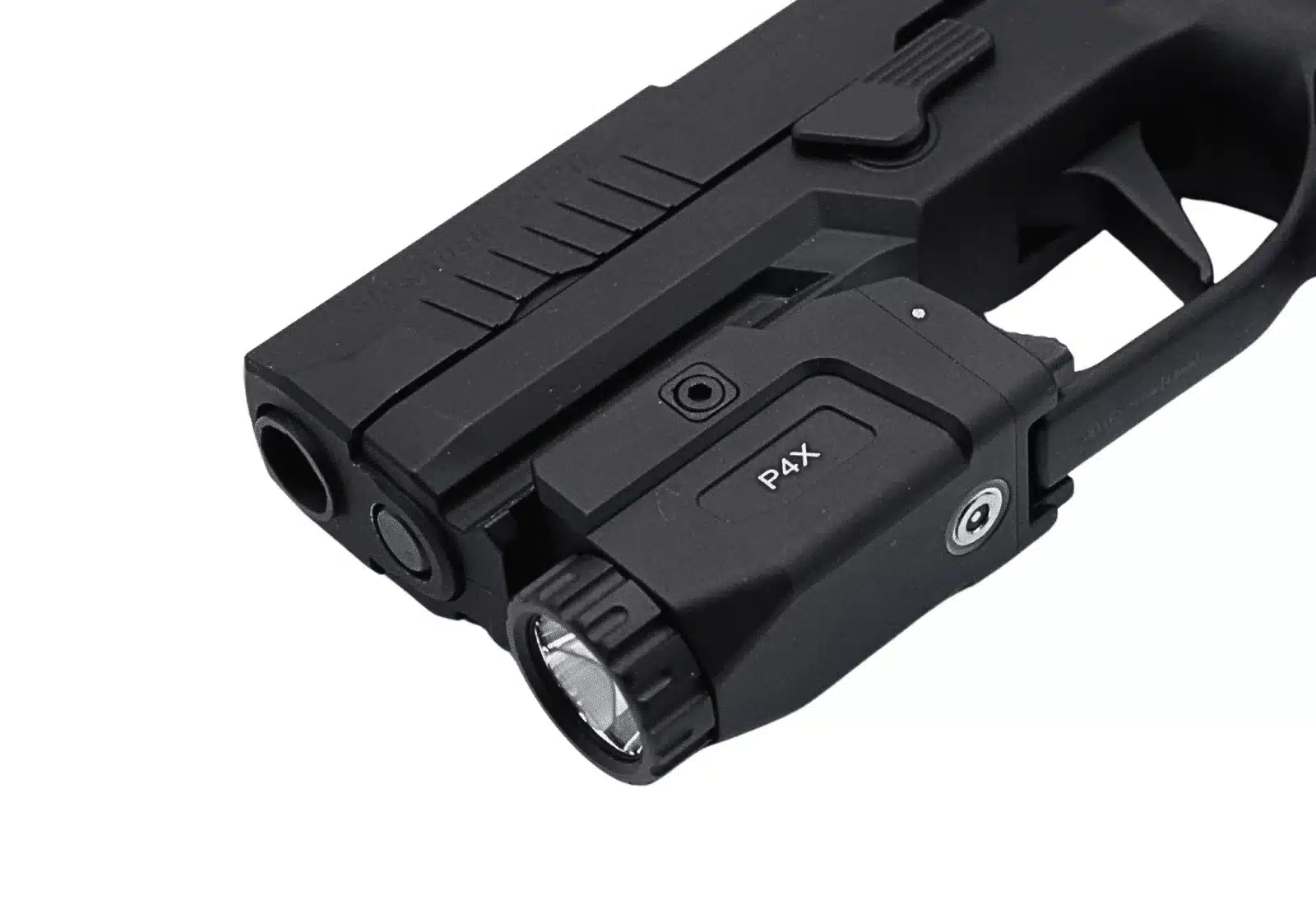
One important nuance: candela is largely a reflector and beam-shaping game. Full-size reflectors usually drive the highest candela, which is why platforms like the P4X and Enforcer punch so hard at distance.
But smaller footprints and multi-laser configurations come with real advantages too, and sometimes that means accepting a lower candela number in exchange for compact carry and additional capability. That’s exactly why Peak Performance makes sense at 9,000 candela, it’s a deliberate balance, not a shortcoming.
The Concept Nobody Explains: Retinal Authority
Here’s the part you won’t find on most spec sheets or review sites, and it matters more than the physics.When you’re in a low-light environment, your pupils dilate. Fully open, the human pupil reaches roughly 7–8mm in diameter. In that state, the eye is extraordinarily sensitive, optimized to extract every available photon from the environment. It’s your night vision, and it takes 20–30 minutes to fully develop.High candela doesn’t just illuminate a target. It overwhelms a dark-adapted eye.We call this Retinal Authority. The ability of a focused, high-intensity beam to flood a fully dilated pupil with more photons than the visual cortex can process, causing instant, involuntary disruption. Startle response. Flinch. Temporary loss of situational awareness. In a threat, this buys you something more valuable than any piece of gear: time.Why This Is Tactical, Not Just Optical
The disorientation from a high-candela beam aimed at a dark-adapted eye doesn’t just reduce their vision, it triggers a primitive neurological response. Their brain is receiving too much signal. For roughly 1–2 seconds, their threat-assessment capability is interrupted.
In defensive shooting, 1–2 seconds is the difference between a reactive shooting situation and a controlled one. Candela creates that gap.
A high-lumen flood light? It lights up the room. A high-candela spotlight? It owns the room, specifically the eyes of whoever you’re illuminating. For law enforcement, home defenders, and anyone whose weapon light might be used to identify and deter a threat, this distinction is not academic. It’s operational.
The Inverse Square Law: Your Secret Weapon
Here’s a little physics that actually works in your favor, and explains why the candela specs on compact lights are so important at typical engagement distances.Light intensity follows the inverse square law: double the distance, and you get one-quarter the intensity. This sounds like a limitation, but flip it around: cut the distance in half, and intensity quadruples.The average home defense engagement distance? Under 21 feet. Many documented incidents happen inside 10 feet. At these ranges, a weapon light’s candela output hits an unprotected eye at nearly its peak rated intensity.Candela Intensity vs. Distance — The Inverse Square Law
100%
5 ft
Full power
25%
10 ft
Still dominant
6%
20 ft
Effective ID
1.5%
40 ft
Diminished
At 22,000 candela, even “25% intensity” at 10 feet delivers approximately 5,500 candela directly to your target, well above most lights’ peak output.
Think about that number. A weapon light rated at 22,000 candela, at a distance of 10 feet, is still delivering roughly 5,500 candela to whatever it’s pointed at. That’s more than the peak rated output of many budget lights, at range.
This is the mathematical argument for why high-candela compact lights are not overkill for home defense, they’re purpose-built for it.The Candela Spectrum: What You Actually Need
Not every shooting scenario demands maximum candela. Range, environment, and role all affect the ideal spec. Here’s how to think about it:Candela by Role — What’s Enough?
Close Quarters / EDC
15,000+
Home Defense
10,000+
General Duty Use
7,000+
Target / Laser ID
4,000+
Ambient / Utility
1,000+
The reason EDC and close-quarters applications demand the most candela, is exactly because of the inverse square law working in reverse. At arm’s length distance, every extra candela translates directly to retinal authority on target. You want that in a defensive context.
A light that looks modest on paper can still be operationally effective when its candela is focused correctly. And a light that blinds you with a lumen count might scatter that output so widely that it washes out your own night vision and tells you nothing about what’s in the shadows at the edge of the flood.The worst-case scenario with a weapon light: lighting up the room around the threat while the threat remains a silhouette. High lumens, low candela does exactly this.
Hilight Tactical New Arrival
The P4X
Built around the candela argument. Every decision made to maximize it.
Candela
22,000 cd
Lumens
1,150 lm
Runtime (High)
55 min
Runtime (Low)
3 hrs
LED
Luminus SST20
Charge
Magnetic
Everything described in this blog was, in part, written because of this light. The P4X is Hilight’s answer to a market full of products that compete on lumens while ignoring the metric that actually matters in the field.
At 22,000 candela, it sits above many full-size duty lights, in a compact package that’s nearly an inch shorter than competitor equivalents and designed from the ground up to clear a holster without snagging. The paddle switches are rear-facing, meaning no accidental activation during draw. The beam profile is shaped around a tight, devastating hotspot, exactly the kind of focused output that exploits everything we’ve described above.The Luminus SST20 is not a budget chip. It’s the same emitter family used in lights that cost significantly more, and the reason the P4X can hit a 22,000 candela spec without inflating lumen numbers to compensate for optical inefficiency.If you carry every day, keep a light on a home defense firearm, or work in a role where your weapon light is part of your toolkit, this is what the spec argument leads to.View the P4X →Where to Start: The Right Light for Your Mission
P3X
4,200 Candela
500 Lumens
Subcompact ready. Tight beam for a light at this price point. Solid entry into candela-aware shooting.
Shop P3X →Enforcer 2
19,000 Candela
700 Lumens
Full-size duty profile with green, blue, or cyan laser. Sealed magnetic charge port. Best-selling combo for a reason.
Shop Enforcer 2 →Peak Performance
9,000 Candela
700 Lumens
The balance pick. Same LED family, different beam geometry. Smaller footprint & dual-color laser.
Shop Peak Series →P4X
22,000 Candela
1,150 Lumens
Top of the lineup. Best-in-class candela in a compact form. Luminus SST20. Designed around holster use.
Shop P4X →The Takeaway
Lumens will keep showing up on boxes because it’s a number that sounds impressive and is easy to compare. But now you know what it doesn’t tell you: how that light performs when it matters, at the distance that matters, against a dark-adapted eye in a real scenario.Candela is beam intensity. Candela is throw. Candela is the retinal authority that a flood light with twice the lumens simply cannot deliver.When you’re shopping for a weapon light, flip past the lumen headline. Find the candela spec. Consider the optics behind it and the chip driving it. And ask yourself, does this light actually concentrate its output, or does it just produce a lot of it?At Hilight Tactical, we’ve been building lights that answer that question correctly since 2007. Same internals as the names you know. American support. Fair prices. And now, the P4X: a compact weapon light built to win the candela argument outright.— The Hilight Tactical Team · hilighttactical.com